Cloud Hosting Engineered Without Compromise
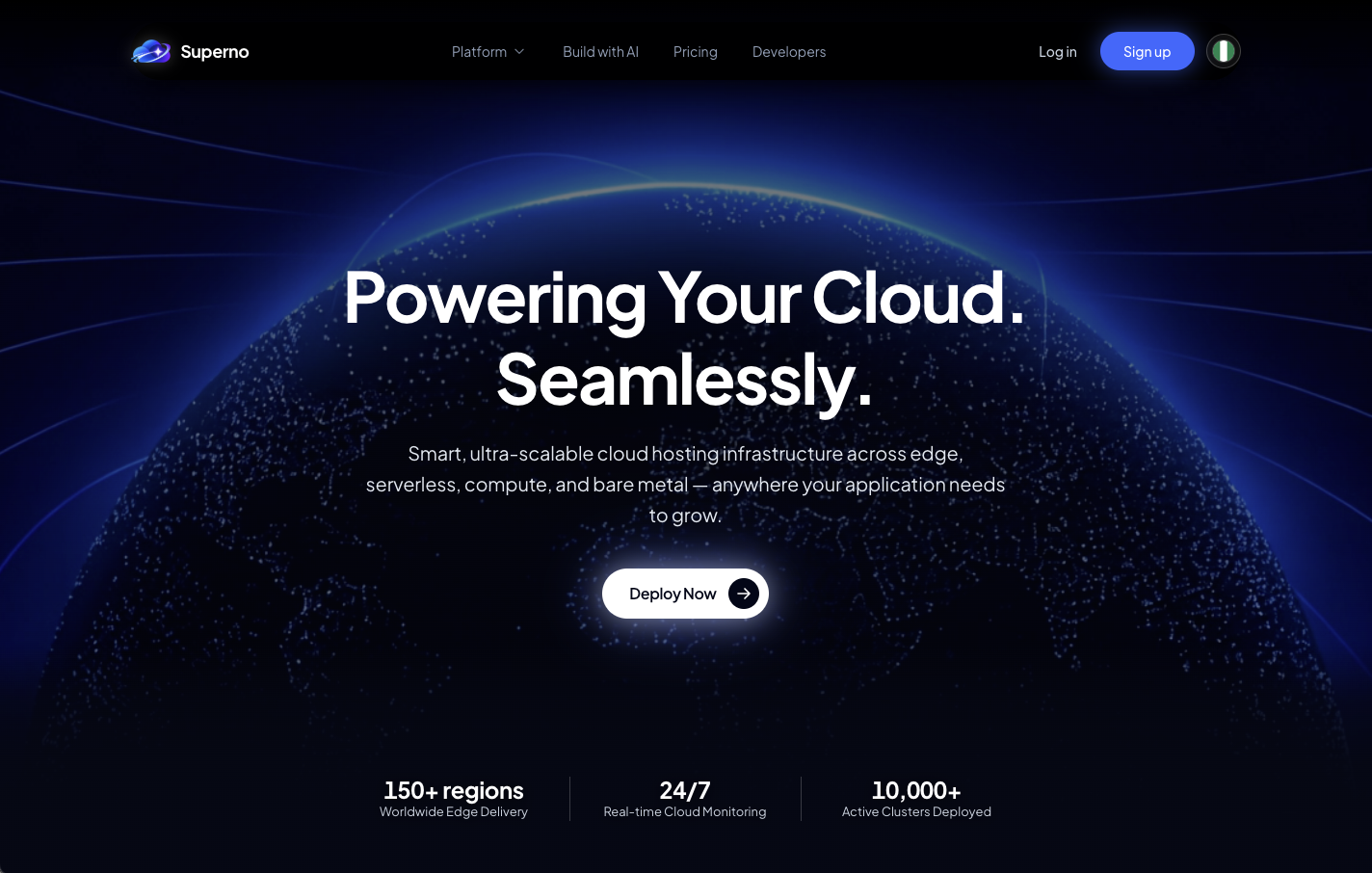
Cloud hosting with zero-egress economics, edge functions, serverless compute, custom domain email inboxes, Anycast edge routing, and native Naira payment rails.
Overview
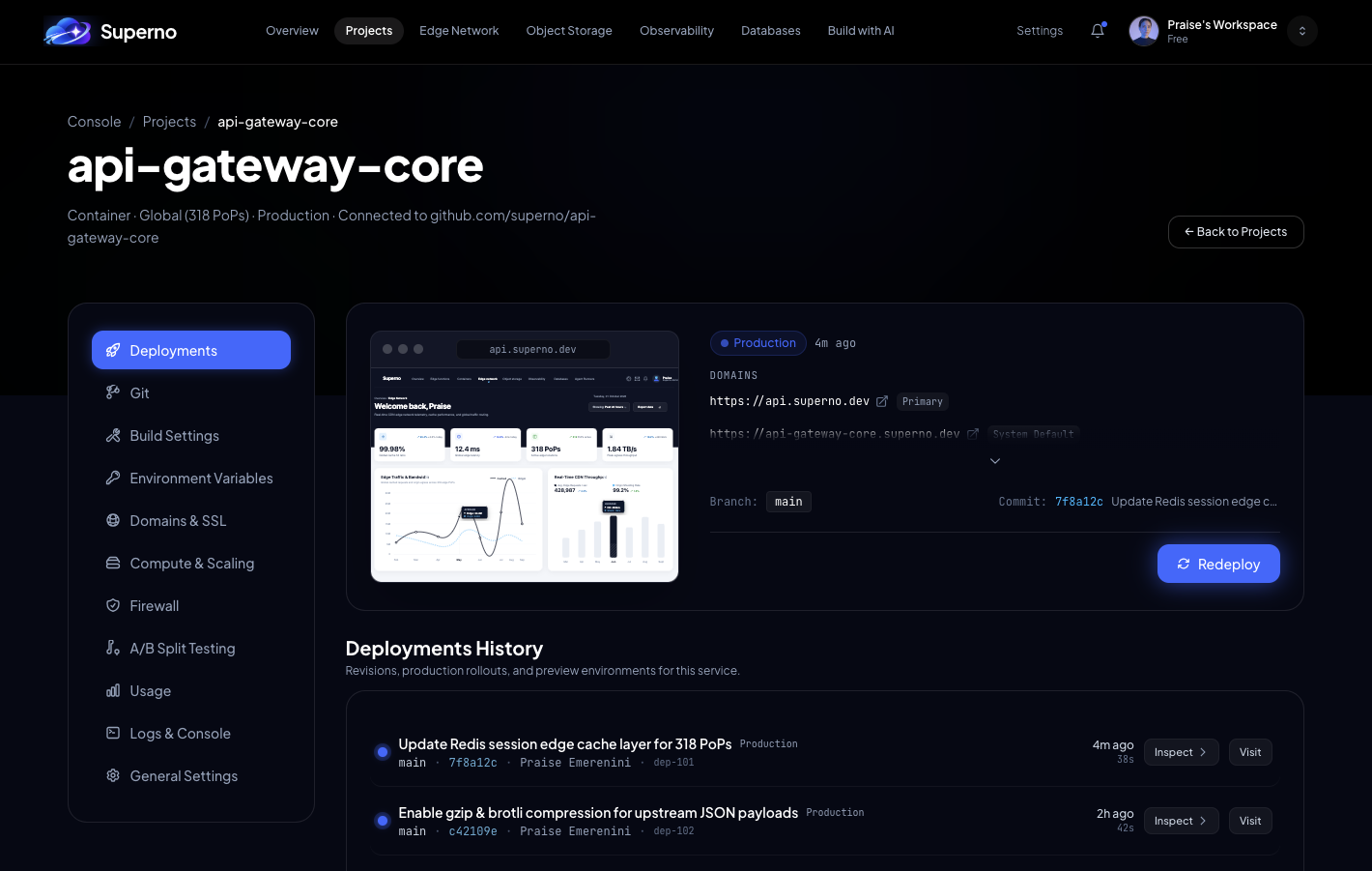
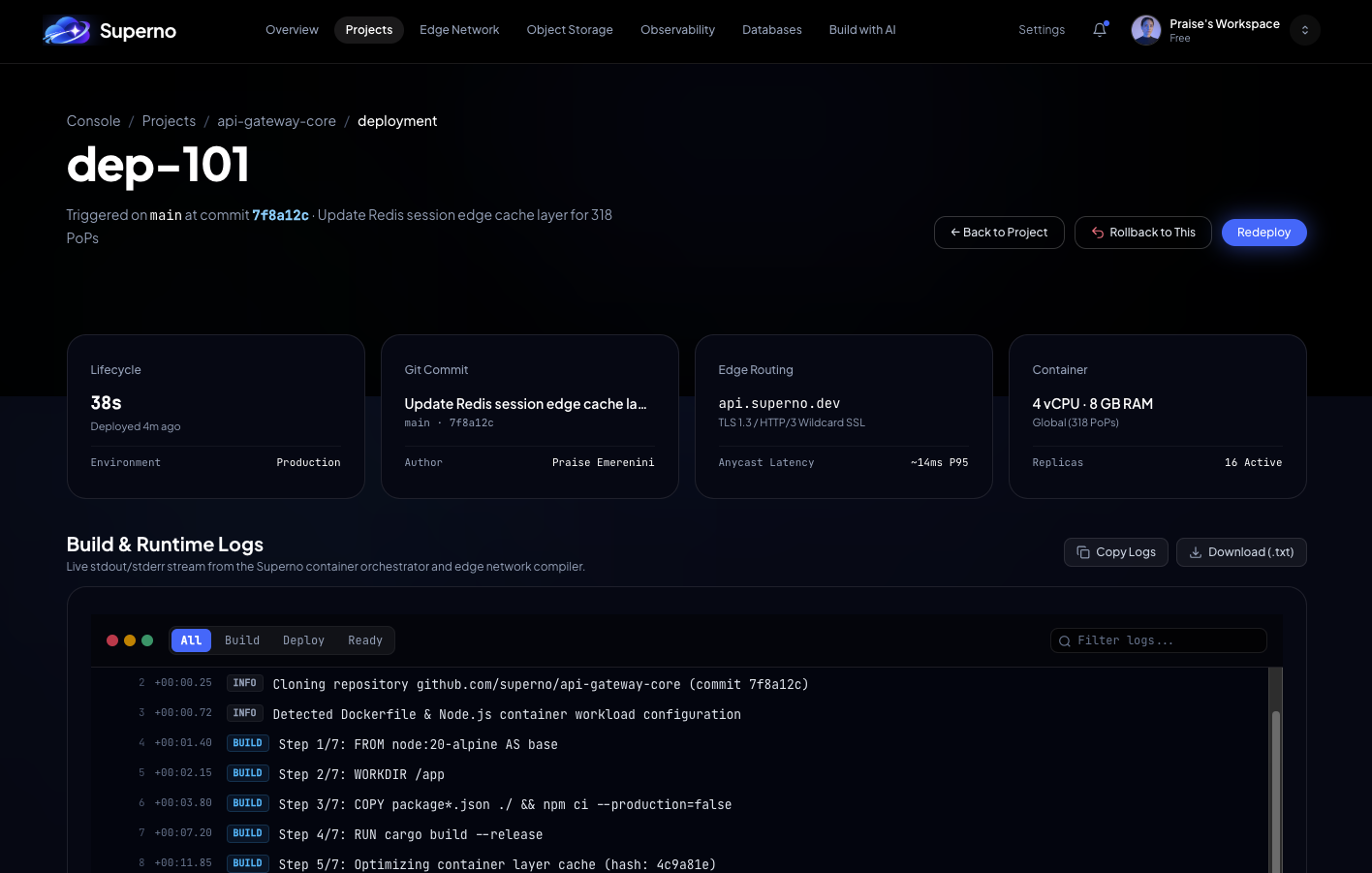
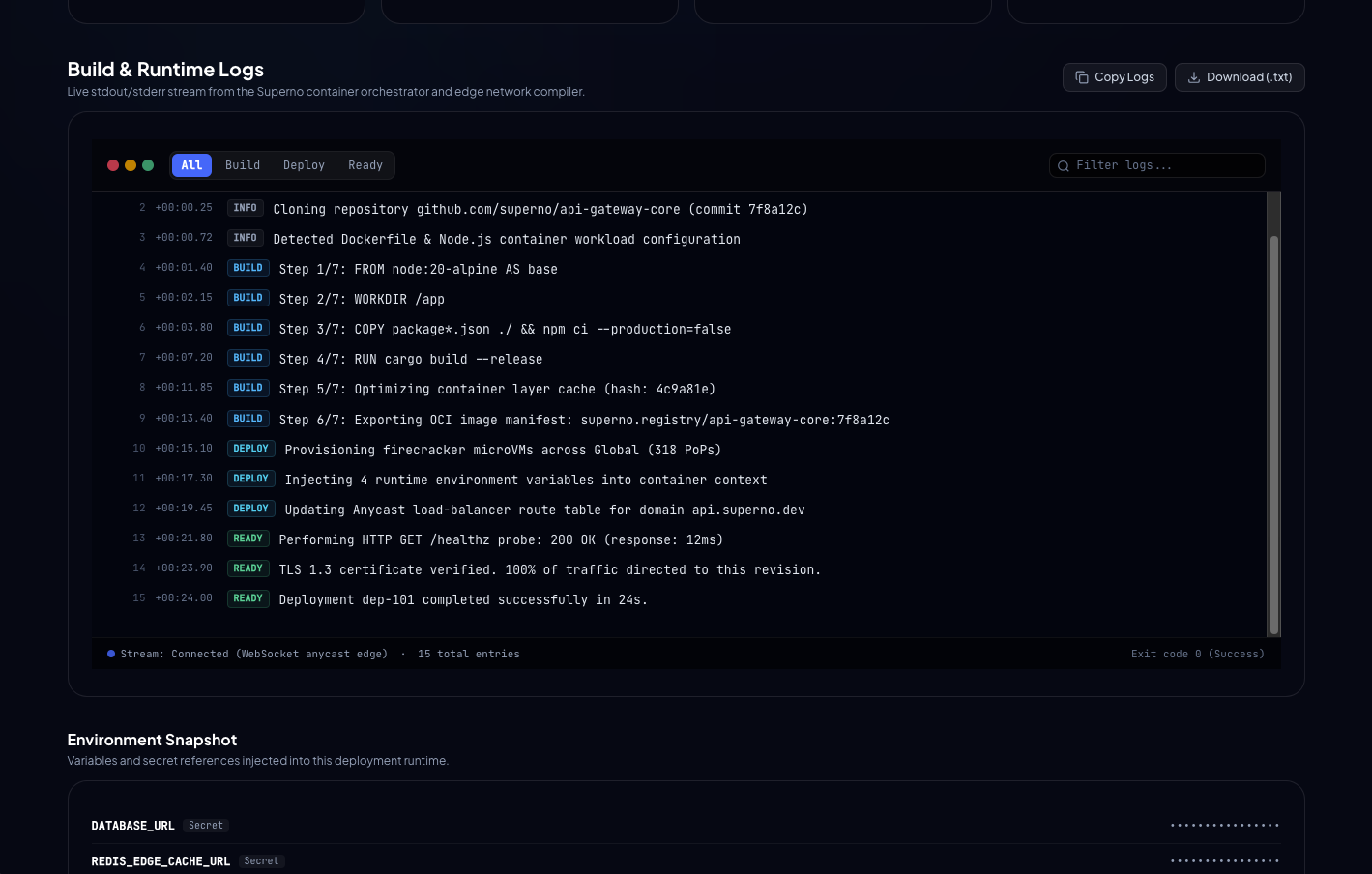
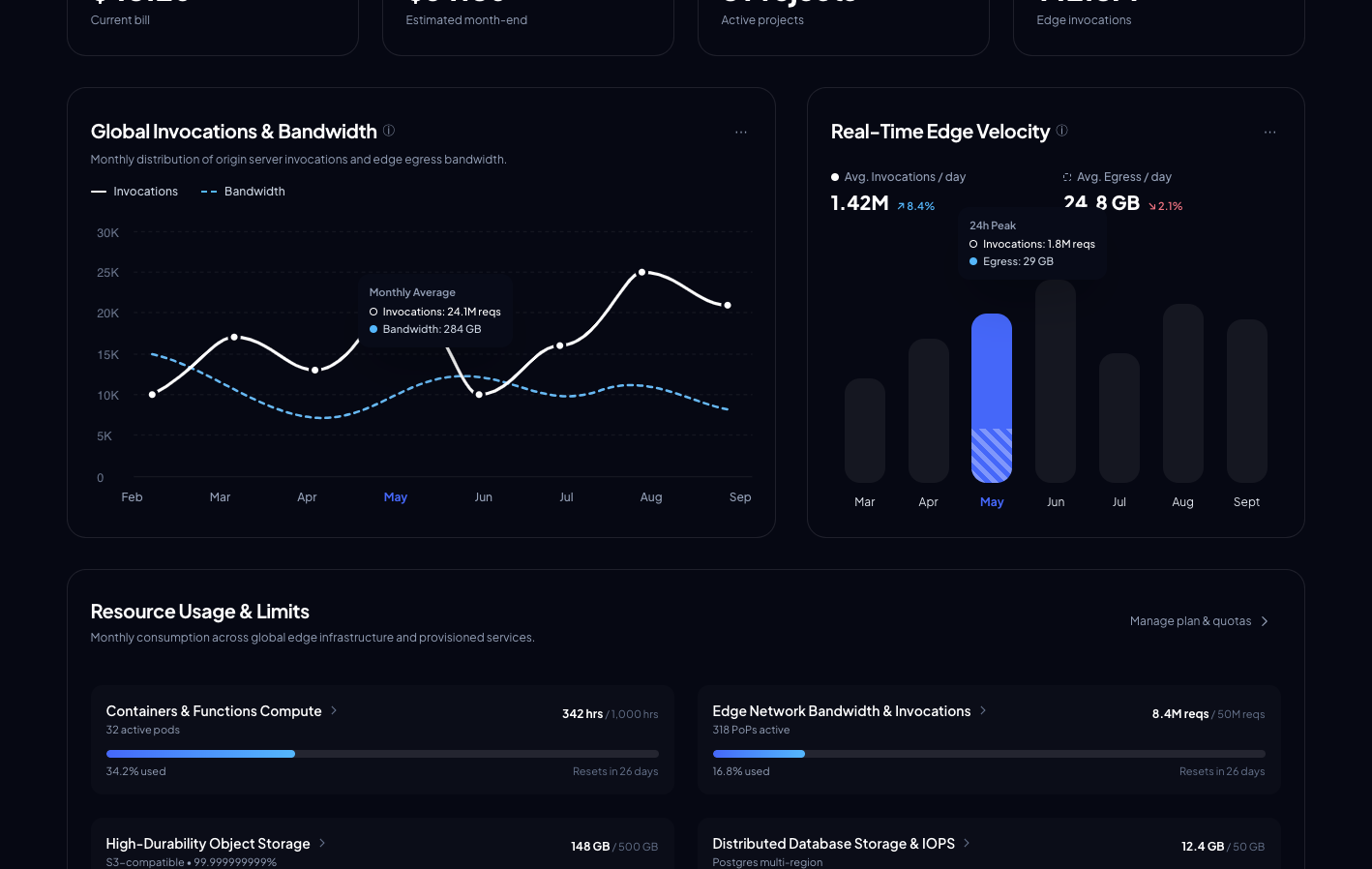
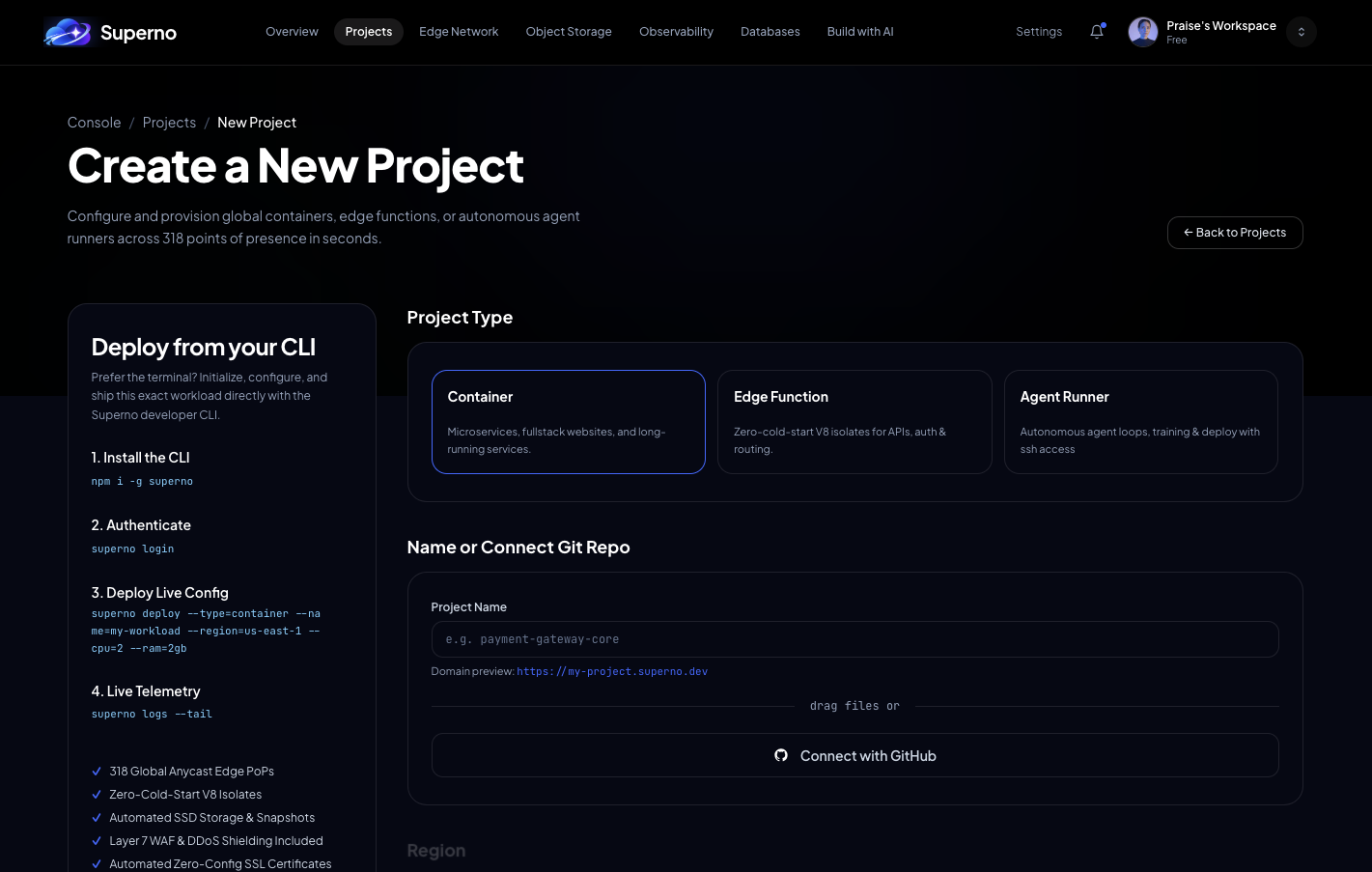
Superno redefines modern cloud hosting by eliminating multi-vendor fragmentation and artificial billing taxes. By coupling Cloudflare Anycast and GeoDNS with an ultra-lean K3s cluster engine deployed across 4 datacenter regions, Superno provides zero-egress hosting, automated custom domain email inboxes, micro-containers, managed databases, an AI code builder, and native Naira payment rails in one unified platform.
Zero Egress Billing
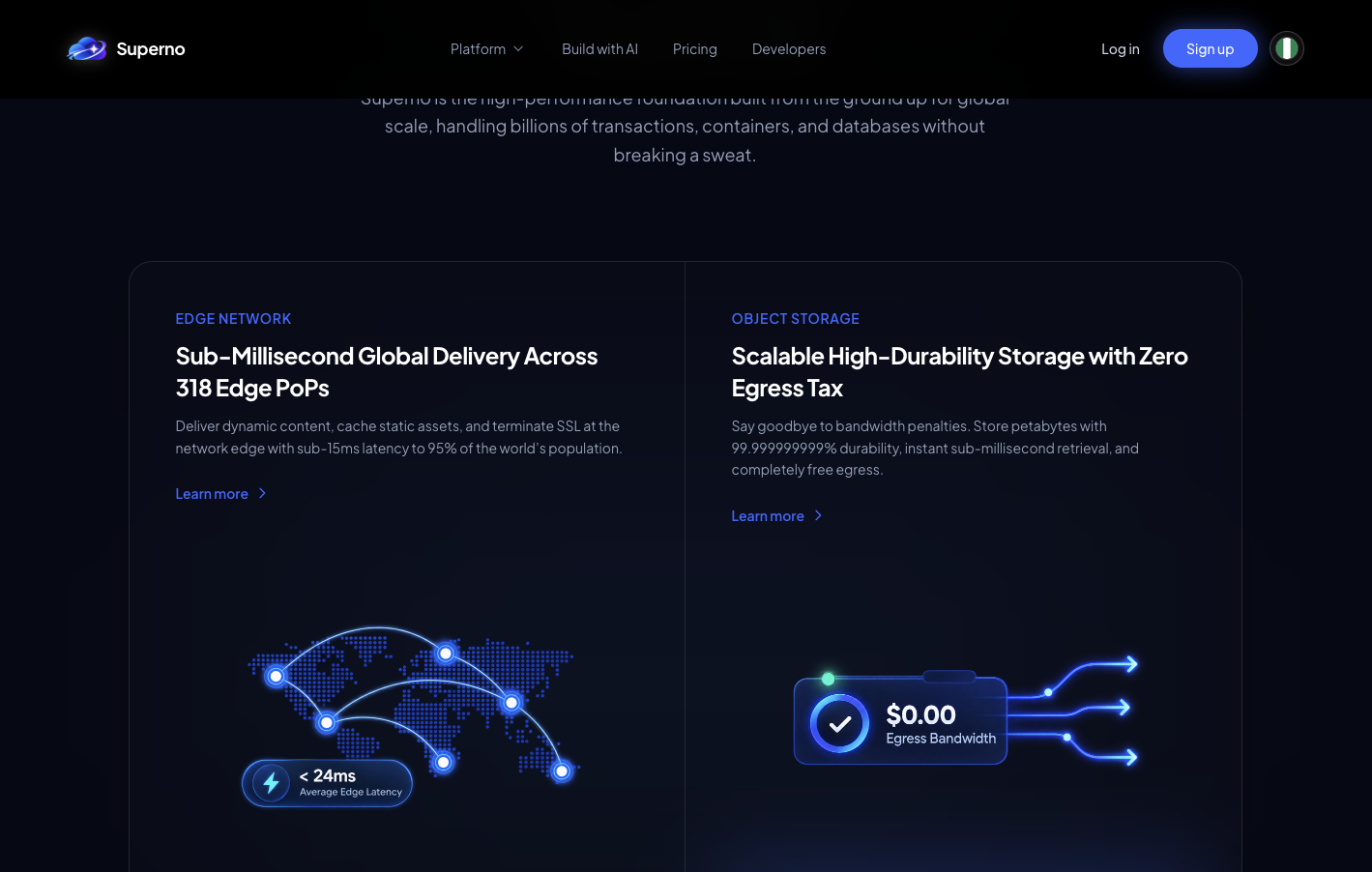
Asset transfers and object storage without predatory bandwidth fees.
Custom Domain Mailboxes
Full MX, IMAP, and webmail inboxes built into every custom domain.
Local Naira (NGN) Rails
Frictionless checkout in Nigerian Naira without international card limits.
Lean Kubernetes Architecture
Containers running without heavy Caddy, Cilium, or BGP ingress overhead.
The challenge
Traditional cloud hosting platforms still force developers to provision heavy, bloated virtual machines just to power lightweight customer Node.js services—wasting compute, memory, and money on idle container runtimes. Concurrently, modern PaaS providers fail to provide native email mailboxes after a user attaches a custom domain, forcing teams to purchase external workspace subscriptions. Finally, developers and technology businesses in emerging markets—especially Nigeria—face severe international payment barriers, unpredictable currency swings, and constant foreign card declines without localized Naira payment options.
Architecture & Strategy
I analyzed top competitors—Cloudflare, Vercel, and AWS Lightsail—each excelling in narrow directions with stark operational compromises. Rather than settling for fragmented trade-offs, I synthesized their core strengths and converted their limitations into our primary differentiators: combining zero-egress economics, lean micro-pod containers, native custom email boxes, edge functions, AI runners, and direct Naira billing into a singular high-performance control plane.
Engineered capabilities
Zero Egress Bandwidth
Predictable hosting with no hidden data transfer fees or egress bills.
Custom Domain Mailboxes
Instant webmail & IMAP accounts provisioned automatically with DNS.
Native Naira Payments
Pay directly with local debit cards and bank transfers without FX caps.
Lean Kubernetes Architecture
Run small customer Node.js services with 90% less RAM overhead.
Anycast Edge & Security
Sub-15ms worldwide TTFB with automated TLS and enterprise DDoS shield.
AI Runner & Code Builder
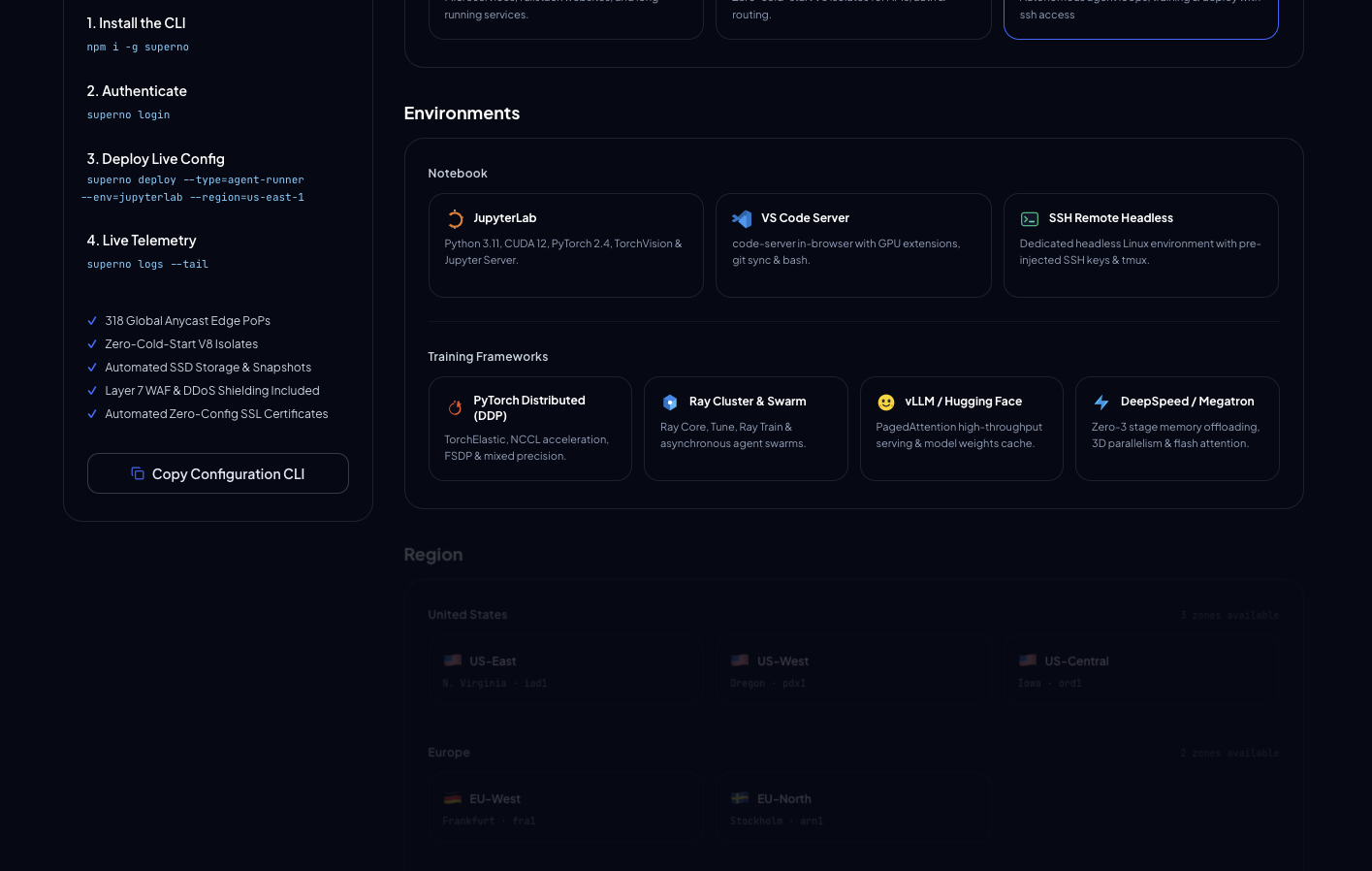
Integrated developer AI harness with GPU-accelerated serverless execution.
Technical benchmarks
Traditional cloud hosting forces developers to choose between expensive serverless lock-in, unmanaged virtual machines with heavy overhead, or complex multi-vendor toolchains. Superno re-engineers cloud hosting from the foundation up by taking the strengths of incumbent giants and turning their weaknesses into our core advantages.
Competitive Matrix
| Feature & Capability | Superno | Cloudflare | Vercel | AWS Lightsail |
|---|---|---|---|---|
| Egress Bandwidth Billing | $0 / GB (Included) | $0 / GB on Workers | $0.15 / GB over quota | $0.09 / GB over quota |
| Custom Domain Email Mailboxes | Included (Native MX & IMAP) | Forwarding Only (No Inbox) | None (Requires 3rd Party) | Amazon WorkMail ($$$ Addon) |
| Local Naira (NGN) Payments | Native Cards & Bank Transfer | USD Credit Card Only | USD Credit Card Only | USD Card Only (FX limits) |
| Runtime Container Flexibility | ** Pods or WasmEdge (Node, Go, Rust)** | V8 Isolates Only | Serverless Functions | Monolithic EC2 VM |
| Minimal Service RAM Overhead | 42 MB (Ultra-Lean) | ~30 MB (Isolates) | ~128 MB (Cold Start) | 380 MB - 512 MB (Full OS) |
| Edge GeoDNS & TLS Automation | Cloudflare Anycast | Cloudflare Global | AWS Global Accelerator | Route 53 Manual Setup |
| AI Runners & Code Builder | Built-in Inference & Harness | Workers AI | AI SDK Wrappers | Bedrock / SageMaker ($$$) |
| All-in-One Developer Portal | Apps + DNS + Mail + DB + AI | Fragmented Dashboard | Frontend Centric | Fragmented AWS Console |
Global Anycast TTFB Response Time Range
Benchmarked across 10 global test probes across North America, Europe, Asia, and Africa.
Container Memory Overhead for a Lightweight Node.js App
Demonstrates Superno's lean K3s pod footprint compared to heavy VMs and traditional orchestrators.
Total Monthly Cost for 5 Small Apps + 100GB Egress + 5 Domain Mailboxes
Complete cost accounting factoring in bandwidth overages and external email inbox subscriptions.
Architectural Deep Dive
Superno's architecture is engineered around three pillars: decoupling ingress complexities to a distributed global edge, running a razor-thin cloud-native engine on high-performance bare metal, and keeping the control plane ultra-responsive with Go and declarative automation.
1. Global Edge and Ingress Layer
Rather than burdening individual cluster nodes with heavy ingress controllers (such as Caddy, Nginx Ingress, or Cilium BGP peering) and self-hosted DNS daemons (like PowerDNS), Superno utilizes a decoupled, Anycast-routed Edge Network to handle global traffic ingestion:
- Automated SSL & Custom Hostnames: • When a user connects a domain, Superno dynamically provisions SSL certificates and TLS edge endpoints via our automated upstream API. This eliminates the need for round-trip ACME challenges to hit your host nodes.
- Enterprise GeoDNS & Anycast: Ingress traffic is automatically routed to the nearest of over 300 edge data centers worldwide. This isolates TLS termination to the absolute edge of the network, dropping connection latency to under 15ms.
- DDoS Mitigation & WAF: Layer 3, 4, and 7 network attacks are fully scrubbed upstream at the edge, ensuring malicious traffic is neutralized before it ever reaches our core data center nodes.
2. Multi-Region Datacenter Fabric (Dedicated Server Pools)
Superno runs on dedicated bare-metal cloud servers across 4 strategic global datacenter regions, achieving high compute densities and predictable cost efficiency:
| Datacenter Region | Geographic Hub | Target Workloads | Regional Latency SLA |
|---|---|---|---|
eu-central |
Falkenstein & Nuremberg (Germany) | Primary Control Plane, Western & Central Europe | < 18ms |
us-east |
Ashburn, Virginia (USA) | Transatlantic Traffic, US East Coast | < 22ms |
us-west |
Hillsboro, Oregon (USA) | West Coast Americas, Trans-Pacific Traffic | < 28ms |
apac-se |
Singapore Hub | Southeast Asia, Australia, Indian Subcontinent | < 35ms |
3. The Control Plane Stack
Every layer of Superno's system was chosen to eliminate waste and guarantee high reliability:
- Go: Kubernetes k3s is written in Go, and Go is the undisputed standard in cloud-native engineering. With its negligible memory footprint, static binary deployments, and goroutine concurrency, our core control plane API delivers sub-millisecond dispatching without garbage collection pauses.
- Node.js & TypeScript: Powers the customer web console, developer CLI, and interactive builder interfaces−ensuring end-to-end type safety.
- Terraform (Infrastructure as Code): Every datacenter region, node autoscaler group, and networking bridge is codified in declarative Terraform files, allowing new regional nodes to spin up in under 60 seconds.
- Helm Charts (Single Point of Control): The entire multi-service stack−including container scheduling, database operators, monitoring daemons, and internal mail routing−is packaged into declarative Helm charts. Deploying a new feature, executing an in-place upgrade, or rolling back a release is completely atomic.
Measurable outcomes
Product gallery
Future iterations
Introducing serverless edge KV storage, distributed cron workers, preview branch environments, and collaborative team permissions.
Sonaonchain
A decentralized developer platform uniting three specialized engines: SonaCloud for serverless compute, SonaStorage for persistent object storage, and SonaMusic for zero-egress audio streaming.